

Why EPA?
Have you heard that EPA is converted to DHA anyway, so you might as well take an oil rich in DHA first as last?
Many people think that omega-3 is one thing. In reality, omega-3 is actually 8 fatty acids, but only one of them does the job.
Achieve fatty acid balance with Sanomega
EPA does the job
The image accompanying this article shows an overview of all omega-3 fatty acids, all omega-6 fatty acids and the enzymes used to convert the different fatty acids into new fatty acids/eicosanoids. The eicosanoids highlighted in green reduce inflammation, while the eicosanoids in red increase inflammation. We need both, but most of us, due to our diet, have too much arachidonic acid (AA) compared to eicosapentaenoic acid (EPA).
EPA is converted into anti-inflammatory eicosanoids. The balance between anti-inflammatory and pro-inflammatory eicosanoids is important in many diseases. Not just when you get a stroke or shin splints. Many of our most common diseases are associated with inflammation. Even obesity is associated with inflammation. Getting enough EPA can help us reduce the level of inflammation in the body, and thus improve our overall health.
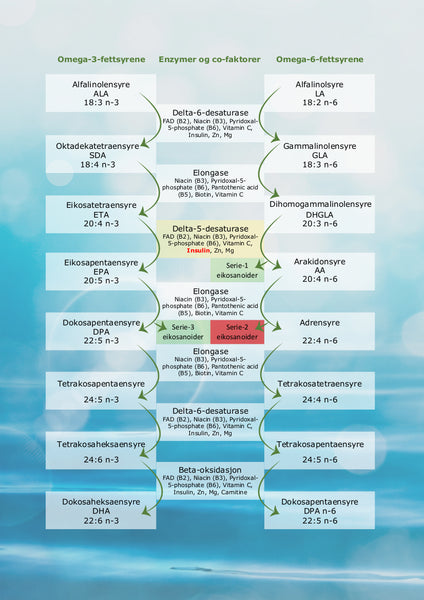
EPA is consumed all the time. Some is converted into eicosanoids, while some goes further down the omega-3 chain and ends up as DHA. DHA is very important, but it is not consumed continuously like EPA. Deficiency is therefore rarely a problem when it comes to DHA.
Since DHA is the most common fatty acid in the brain, it is natural to believe that we get the best effect if we use fish oil that contains more DHA than EPA. However, studies show that a high EPA content is the most important. This is the brain's fatty acid paradox:
- EPA prevents DHA from detaching from the cell membrane. Thus, EPA has an important protective function.
- EPA can be converted to DHA. Sufficient supply of EPA thus enables the body to self-regulate the correct DHA level.
Omega-3 supplements high in EPA will therefore be a better choice than supplements high in DHA.


